Fresh Air. The Scent of Pine.
Antarctica
The Monthly Climate: March 2011
In Brief March 2011 began with a major setback to improving NASA climate observation capabilities with the launch failure of the Glory satellite. Intended to improve both solar monitoring and aerosol impacts on global climate, Glory suffered a fate similar to its 2009 predecessor, the Orbiting Carbon Observatory (OCO), which also experienced a launch … Continue reading
State of the Climate, Indicators of Change
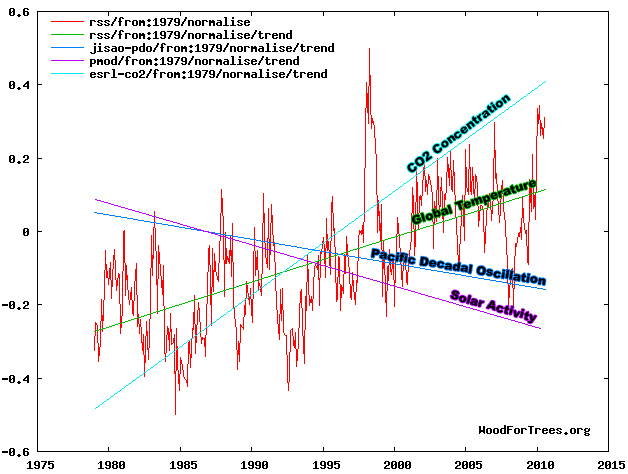
As the United Nations Climate Change Conference in Copenhagen gets into full swing, it’s a good time to take a look around and assess the current state of things. In the 30 years of direct satellite observation… Solar irradiance has declined (Source: PMOD/WRC) which should drive temperatures down, and we are currently in the middle … Continue reading
Climate Change Indicators Updated: Glacial Retreat
The Climate Change Indicators page has been updated to include information on global glacial retreat as documented by the World Glacier Monitoring Service (WGMS). Earlier this year, the WGMS posted glacier mass balance data for 2006 and 2007 for 115 glaciers located around the world from North America, South America, Europe, Asia, and Antarctica. Additional … Continue reading
Changes at the Ends of the Earth
The last few days have seen announcements of some significant changes happening at the Earth’s poles. In Antarctica, the narrow ice bridge which was connecting the Wilkins Ice Shelf to two small islands has snapped, leaving the shelf, which is the size of Jamaica, likely to break away. Rifts in the bridge had been noticed … Continue reading
A Closer Look: Changes in Antarctica
Hasn’t Antarctica actually gained ice mass? When discussing Antarctica, it’s first important to get a sense of scale. Discussions of the Arctic and the Antarctic often confuse the two, but the region around the Earth’s southern pole is much, much larger. Antarctica, the continent, is about 5.4 million square miles in area, which is over … Continue reading
Connect


The Indicators
 Climate Change Indicators
 Global Temperature
 Global Sea Level
 Arctic Ice Melt
 Glacial Retreat
 Atmospheric CO2 Level
 Fresh Air. The Scent of Pine.