Fresh Air. The Scent of Pine.
Climate Change
Ocean acidification threatens entire marine food chains
Not all of the CO2 emitted by human industrial activities remains in the atmosphere. Between 25% and 50% of these emissions over the industrial period have been absorbed by the world’s oceans, preventing atmospheric CO2 buildup from being much, much worse. But this atmospheric benefit comes at a considerable price. As ocean waters absorb CO2 … Continue reading
Global Cooling? Pick a Time, Any Time.
Satellite Record Now Shows Warming Across All Date Ranges I don’t think that anyone disagrees with the fact that we actually are in the middle of a cold period that started about nine years ago. Now that’s not me talking. Those are the scientists who say that. – U.S. Senator James Inhofe, July 23, 2010 … Continue reading
Prof. Stephen H. Schneider (1945-2010)
The scientific community lost one of its great voices this week when Stephen Schneider, Professor of Environmental Biology and Global Change at Stanford University, passed away from a sudden heart attack. Dr. Schneider was an early voice, warning of the dangers of escalating carbon emissions to the global environment, and his contributions to science and … Continue reading
Environmental Headlines, Week of July 17, 2010
The continued impacts and actions revolving around the BP oil spill continued to command the majority of headlines this week with BP becoming cautiously optimistic after finally capping the leak that has spilled tens of millions of gallons of oil over the last 4 1/2 months since its Deepwater Horizon rig exploded in the Gulf … Continue reading
Physics Society Quietly Reaffirms Climate Change Policy Stance
American Physical Society Reaffirms That Human Activities Affect Earth’s Climate. There is a substantial body of peer reviewed scientific research to support the technical aspects of the 2007 APS statement….Greenhouse gas emissions are changing the Earth’s energy balance on a planetary scale in ways that affect the climate over long periods of time (~100 years)….While … Continue reading
Did You Know? – Volcanic Emissions of Carbon Dioxide
Human activities release more than 100 times the amount of carbon dioxide released by all of the Earth’s volcanoes each year.
Global Warming – Back to the Basics
Amidst polls showing a decline in concern over the impacts of global warming, perhaps it is time to revisit the basics. The ability of human carbon emissions to warm the planet was first theorized over 100 years ago, near the beginning of the industrial age. Since that time, the theory has been reinforced by countless … Continue reading
A Closer Look: The Climate Change Debate
Why won’t scientists debate the issue of climate change? There is a problem with debates. It’s called sweat. Vice President Richard Nixon lost the first ever televised Presidential debate to his opponent, Senator John F. Kennedy. At least that’s the conclusion the television audience reached, and it very well may have cost Nixon the Presidency.
Scientific Organizations Acknowledge Human Impact
NOTE: A separate page is now available for the latest updates to this information. Below is a list of scientific organizations around the world that acknowledge the global impact of rising atmospheric greenhouse gas concentrations from human activities. While many more organizations could likely be added, the list is limited to organizations that have either … Continue reading
State of the Climate, Indicators of Change
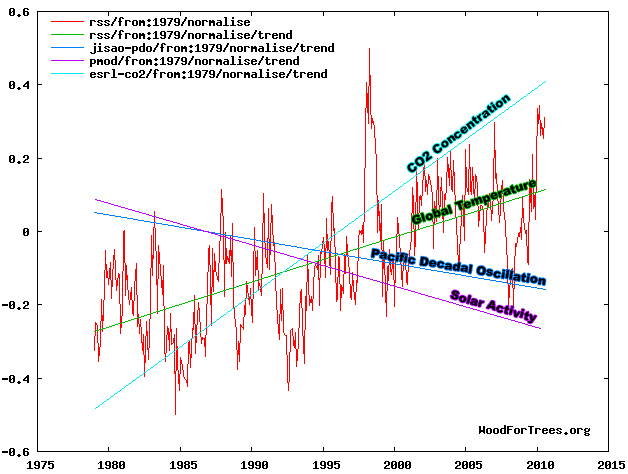
As the United Nations Climate Change Conference in Copenhagen gets into full swing, it’s a good time to take a look around and assess the current state of things. In the 30 years of direct satellite observation… Solar irradiance has declined (Source: PMOD/WRC) which should drive temperatures down, and we are currently in the middle … Continue reading
Connect


The Indicators
 Climate Change Indicators
 Global Temperature
 Global Sea Level
 Arctic Ice Melt
 Glacial Retreat
 Atmospheric CO2 Level
 Fresh Air. The Scent of Pine.