Fresh Air. The Scent of Pine.
Skeptics
No Warming Since 1998 – Old Claim Given New Life
A recent article by the BBC has given new life to an old myth. The article references conclusions from the UN’s World Meteorlogical Organization that the La Nina conditions responsible for a colder winter will continue through a large portion of the year, resulting in cooler temperatures. This conclusion along with a convenient timeframe has … Continue reading
So Much for the “Global Cooling” Consensus
How often have you heard a skeptic of man-made global warming dismiss current scientific conclusions regarding climate change by referencing a supposed consensus in the 1970s that the Earth was experiencing “global cooling”. The argument generally goes something like… “Thirty years ago, they were telling us we were going to freeze. Now they’re telling us … Continue reading
The Denial Machine
Here is an eye-opening video from Dr. Naomi Oreskes of the University of California at San Diego. As you may or may not recall, it was Dr. Oreskes who surveyed 928 papers on climate change published in the major scientific journals between 1993 and 2003 and found that 75% of the papers published during that … Continue reading
A Closer Look: Predicting the Climate
If we can’t accurately predict the weather next week, how can we predict the climate in a hundred years? Weather is not the same as climate. Weather deals with very short term variability as it pertains to a specific geographical area. As such weather deals with a very large amount of variability day-to-day and even … Continue reading
A Closer Look: Global Temperatures Since 1998
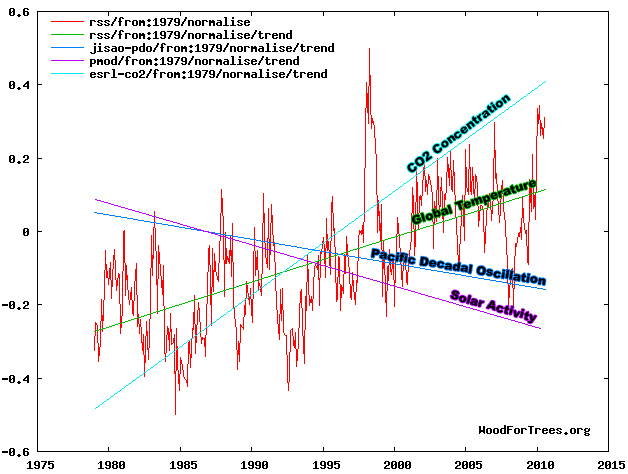
Didn’t warming end in 1998? See also: No Warming Since 1998: Old Claim Given New Life Last Updated: March 9, 2009 No. 1998 is considered widely to be the hottest year globally on record. While anthropogenic global warming (AGW) certainly contributed to the warmth that year, it was supported by what some scientists call the … Continue reading
A Closer Look: Earth’s Climate of the Past
Hasn’t the Earth heated and cooled all on its own in the past? Yes. Many times. There are many natural variations and events that impact the Earth’s climate including changes in the Earth’s orbit around the Sun, changes in the tilt of the Earth on its axis, changes in solar output, volcanic activity, shifting of … Continue reading
You don’t honestly think human activities will destroy the planet, do you?
Absolutely not. The Earth has been around for billions of years, long before the arrival of mankind, and it will likely still be around long after we are gone. The question is not whether or not the Earth will be destroyed but whether or not the changed Earth will be a hospitable place for us … Continue reading
A Closer Look: CO2 Lagging Temperature
Don’t increases in temperature lead to increases in CO2, not the other way around? Yes and no. Increases in global temperature can lead to an increase in atmospheric levels of CO2. However, as CO2 is added to the atmosphere, it traps additional heat causing a further rise in global temperatures. Source: U.S. EPA As you … Continue reading
A Closer Look: Human vs. Natural CO2 Emissions
Aren’t human emissions of CO2 a fraction of those from natural sources? Absolutely. Emissions of CO2 from human sources are dwarfed many times over by emissions of the gas from natural sources. However, it is the human emissions that are throwing off the balance. Take mankind out of the equation, and the Earth’s climate reaches … Continue reading
A Closer Look: The Solar Influence
Isn’t the Sun driving current climate change? Last updated: February 9, 2009 No. Perhaps a better question would be, “Is the Sun contributing to current climate change?” In that case, the answer would be yes. The Sun goes through a 22-year cycle consisting of two 11-year components. At the end of each of these 11-year … Continue reading
Connect


The Indicators
 Climate Change Indicators
 Global Temperature
 Global Sea Level
 Arctic Ice Melt
 Glacial Retreat
 Atmospheric CO2 Level
 Fresh Air. The Scent of Pine.